What Did AOD-9604 and hGH Fragment 176-191 Do?
Fat cells changed in lab work. People did not lose more weight.
What result should you know first?
AOD-9604 and the hGH fragment 176-191 refer to nearly the same copied part. The part comes from the end of human growth hormone. That hormone helps build tissue, raises IGF-1, a growth-related blood number, and also affects fat. Researchers linked its fat work to parts 176 through 191.
AOD-9604 copies that stretch with a small change. It affects fat cells without using the usual doorway for full growth hormone. It does not raise IGF-1. In animals, it slowed fat-making and increased a beta-3 switch, which helps burn stored fat.
Animal work can show how the copied part may act, but it can't settle whether you will lose weight. The human study showed no weight-loss edge for the drug. The next sections explain how the lab work led to that test.
Why do the names use parts 176-191?
The numbers show places along growth hormone. Researchers linked its fat work to an end stretch around parts 176–191 [14]. AOD-9604 copies parts 177–191 and adds one protein building block at the front. Papers call the source area hGH fragment 176-191 [3].
Two parts of the chain are joined by a small chemical bond. That bond makes a loop like one in the full hormone. The loop helps the short chain hold its shape. You don't need the lab name for the bond to follow the result.
Full growth hormone uses one cell doorway and raises IGF-1, a growth-related blood number. The hGH fragment 176-191 avoids that doorway and does not raise IGF-1 [3]. Researchers hoped to keep an effect on fat without the IGF-1 growth effect. That hope was the reason for making the short part.
How did the copied part slow new fat?
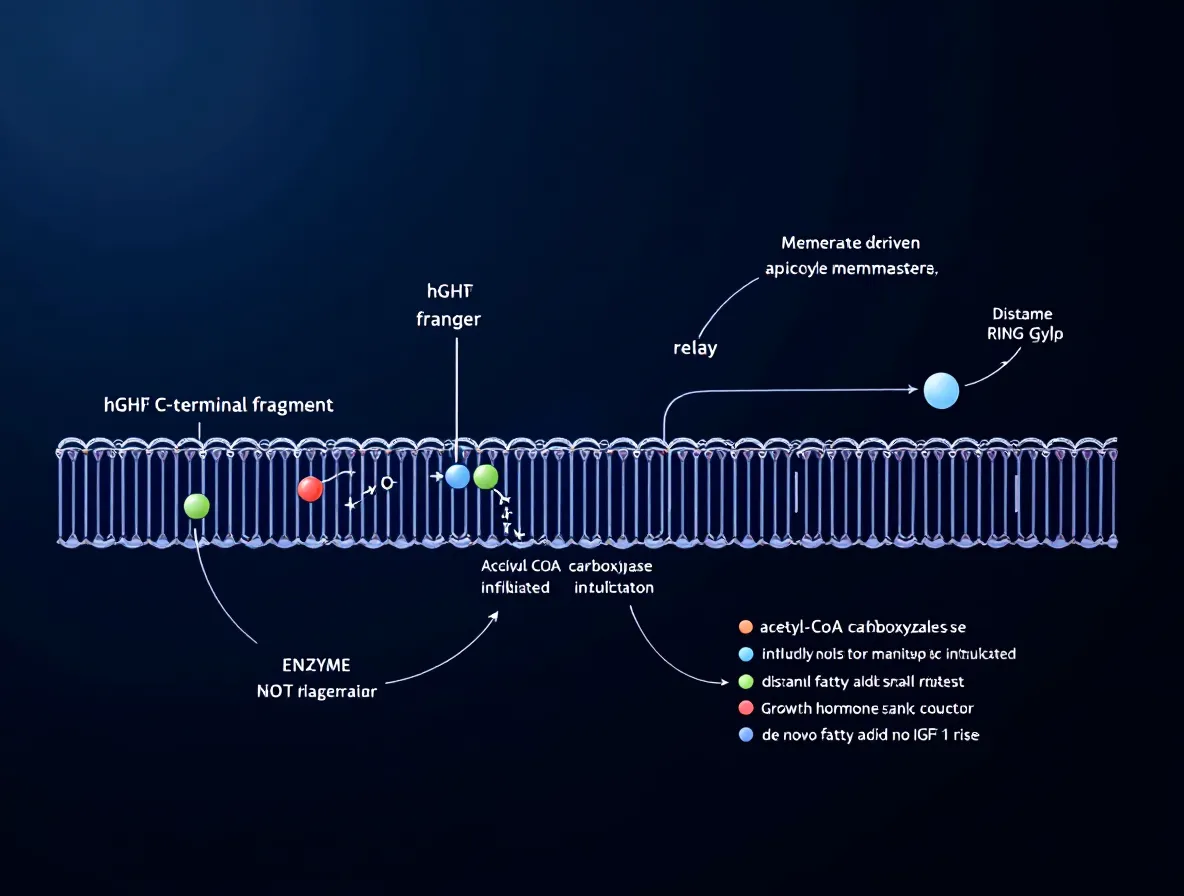
The hGH fragment 176-191 first touches the outer wall of a fat cell. An older test used a slightly longer piece numbered 172–191. That contact sent a message into the cell and slowed a helper that makes new fat [4].
The same work studied liver cells as well as fat cells. It followed the message from the cell wall to that fat-making helper. With the helper slowed, the cells made less new fat. All of this work happened in lab dishes.
Later studies tied the effect to the short lab-made end part [3]. An older test also found changes in how sugar entered rat fat cells [8]. Studies in cells and rodents cannot settle what happens in people. The human weight-loss test still found no clear gain.
What did tests of the beta-3 fat-cell switch show?
Another mouse study looked at a switch on fat cells called beta-3, which helps burn stored fat. Longer use of AOD-9604 increased that switch in obese mice. Mice needed the working switch to keep the longer weight change. A brief rise in energy use and fat burning still occurred without it [1].
A second study found more fat burning and weight loss in obese mice [2]. The two mouse studies support each other. Related work also used rats and cells [3]. Together, the studies show a clear result in animals.
The limit is equally clear. In the main human study, the drug had no weight-loss edge [5][14]. The hGH fragment 176-191 therefore has an animal result, not a proven gain for you. Any claim about people must start with the human finding.